Researchers of the Bible Arabica: The Bible in Arabic among Jews, Christians and Muslims research group
(2013-2018: Deutsche Forschungsgemeinschaft – Deutsch-Israelische Projektkooperation (DFG-DIP), 16th round)
-
Principal Investigators
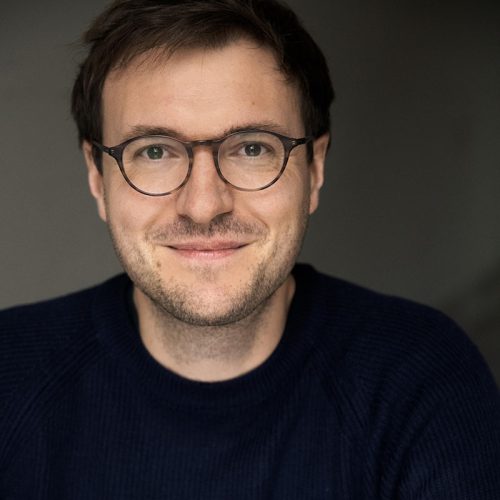
Peter Tarras
Peter Tarras is a research assistant in the DFG-funded project “Arabic and Latin Glossary” based at the University of Würzburg. He is currently completing his PhD thesis, supervised by Prof. Peter Adamson, LMU Munich, under the title “Dysdaimonia: Evil, Free Will, and Eschatology in al-Fārābī”. Peter teaches courses on different aspects of medieval Middle Eastern Judaism at the Institute of Near and Middle Eastern Studies, LMU Munich. As an associated member of Biblia Arabica, he has worked on biblical quotations in Christian Arabic apologetical literature and developed a strong interest in manuscript studies and the history of modern manuscript collections.
For his publications, see http://koenig-ludwig-haus.academia.edu/PeterTarras

Lea Gzella
After initially studying Arabic, I was so intrigued by its language system that I switched to Semitic studies soon afterwards. Throughout my studies, I have thus occupied myself with the broad range of fields that the study of Semitic languages has to offer. As such, Hebrew (Bible and Qumran), Aramaic (Bible, Qumran, and Mandaic), and Judeo-Arabic, as well as work with manuscripts, have emerged as particular areas of interest of mine.
To combine some of these adjacent but distinct fields of scholarship, I decided to write my doctoral dissertation on Ibn Ǧanāḥ’s Kitāb al-uṣūl. This dictionary of Biblical Hebrew, written in Judeo-Arabic in the 11th century, is a seminal work of Hebrew lexicography whose influence is by no means limited to the Middle Ages but extends well into modern times. After his predecessor Ḥayyūǧ had postulated the theory of triliteral roots, which is still prevalent in today’s scholarship, Ibn Ǧanāḥ was able to develop it systematically in his Kitāb al-uṣūl. Moreover, he does not merely offer translations and brief explanations of Hebrew words occurring in the Bible. Frequently, he also engages in elaborate, both theologically and philosophically informed discussions on the meaning of the biblical text as well. Thus, beyond the more technical aspects of lexicographical and grammatical subtleties, the Kitāb al-uṣūl also makes for an intriguing read owing to Ibn Ǧanāḥ’s intellectual originality and versatility.

Jessica Thalmann
I am working as a student assistant at the Institute of the Near and Middle East at Ludwig Maximilian University of Munich.
email
Foto: LMU / Matthias Remmling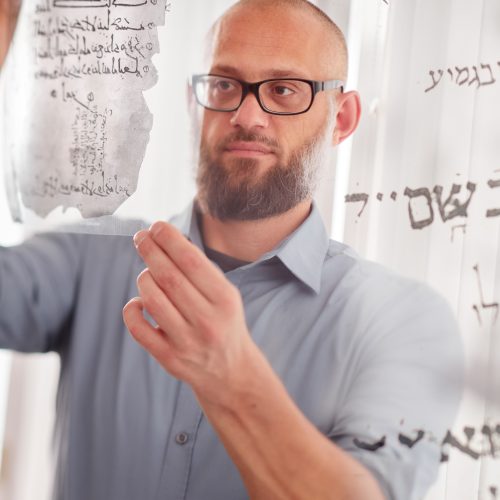
Ronny Vollandt
Ronny Vollandt is Professor of Judaic Studies at the Ludwig-Maximilians- Universität Munich and currently the first chairperson of the German Association of Jewish Studies. His teaching focuses on rabbinic Judaism and on the intellectual history of Jews in the Islamicate world. He researches Arabic versions of the Bible, Judaeo-Arabic literature, and Jewish cultural heritage, and above all manuscripts, in the Near East. He is the author of Arabic Versions of the Pentateuch: A Comparative Study of Jewish, Christian, and Muslim Sources (Brill, 2015, awarded the Boehlig prize in 2017), and co-directed the research project “Biblia Arabica”. Together with Dr Miriam Goldstein (Hebrew University of Jerusalem), he recently received a DFG grant Award for Research Cooperation and High Excellence in Science for the edition, identification, and cataloguing of manuscripts related to Bible exegesis and translation in the Firkovich collections. He is keen on passing on his passion for studying medieval Jewish manuscripts, their codicology, repositories, and acquisition histories to his students (https://www.manuscripthunters.gwi.uni-muenchen.de/).

Maximilian de Molière
In 2021, I completed my dissertation on the library of the 15th-century Christian Hebraist Johann Albrecht Widmanstetter. The goal of this project was to contribute to the history of the Jewish book in the hands of Christian Hebraists. This investigation involved describing and cataloguing the codicological and paleographical features of Widmanstetter’s entire library (195 volumes of manuscripts and printed books) and feeding this information into a TEI-XML database to serve as the basis for analysis. Using this large dataset, I was able to reconstruct the chronology of his acquisitions, the booksellers from whom he sourced new printed books, and how Widmanstetter maintained his library over three decades of his life. Moreover, I was interested in the notes he left in the margins of his books. These marginalia throw new light on why he assessed the relevance of kabbalistic texts to Christianity differently than contemporary Christian kabbalists like Guillaume Postel or Egidio da Viterbo.